
HLP004
HLP004:
Deuterated Novel Serotonergic Agonist Program
HLP004 is currently being evaluated in a Phase 2 study in Generalized Anxiety Disorder (“GAD”). The HLP004 program features:
- Short-duration treatment with convenient dosing
- Demonstrated proof-of-concept in depression and anxiety
- Robust IP protection
Helus Pharma’s internal research has also developed potentially more convenient and patient-friendly dosing methods, including intramuscular (“IM”) dosing.
Development Status: Phase 2 study enrollment complete.
Next steps: Phase 2 HLP004 topline safety and efficacy data in GAD expected Q1 2026.
Intellectual Property
Helus Pharma holds an extensive deuterated NSA IP portfolio, with more than 50 patents protecting the program, including claims directed to composition of matter, methods of use, formulation, and synthesis.
HLP004 is protected by a U.S. composition of matter patent expected to provide coverage until at least 2041.

Target Product Profile for dDMT optimized with data from 5 clinical studies
To date, Helus has completed five clinical trials evaluating the safety and efficacy of CYB004 (dDMT), SPL028 (IM/IV dDMT) and SPL026 (IM/IV DMT), providing key insights informing the development of the DMT program:
Completed Study
Key Findings
(1) Phase 1/2a DMT study in moderate to severe MDD (no SSRIs)
(2) Phase 1 IV/IM DMT study
(3) Phase 1 SSRI DDI study
(4) Phase 1 Study of IV CYB004 (dDMT) and IV DMT
(5) Phase 1 IM/IV dDMT study
DMT demonstrated rapid and durable antidepressant and anxiolytic effect
✓46% of MDD patients in remission at 3 months
✓40% of MDD patients in remission at 6 months
✓Rapid improvement in anxiety and wellbeing scores
✓IV DMT safe and well-tolerated
Characterized safe and well-tolerated IM route and dose selection for DMT and dDMT
DMT safe and well-tolerated when co-administered with SSRIs
Potential enhanced effect when given as adjunctive to SSRIs:
✓92% remission rate in SSRI cohort vs. 20% remission (non-SSRI cohort)
Completed Study
(1) Phase 1/2a DMT study in
moderate to severe MDD (no SSRIs)
(2) Phase 1 IV/IM DMT study
(3) Phase 1 SSRI DDI study
(4) Phase 1 Study of IV CYB004
(dDMT) and IV DMT
(5) Phase 1 IM/IV dDMT study
Key Findings
DMT demonstrated rapid and durable antidepressant and anxiolytic effect
✓46% of MDD patients in remission at 3 months
✓40% of MDD patients in remission at 6 months
✓Rapid improvement in anxiety and wellbeing scores
✓IV DMT safe and well-tolerated
Characterized safe and well-tolerated IM route and dose selection for DMT and dDMT
DMT safe and well-tolerated when co-administered with SSRIs
Potential enhanced effect when given as adjunctive to SSRIs:
✓92% remission rate in SSRI cohort vs. 20% remission (non-SSRI cohort)
De-risking the development of HLP004 in Generalized Anxiety Disorder
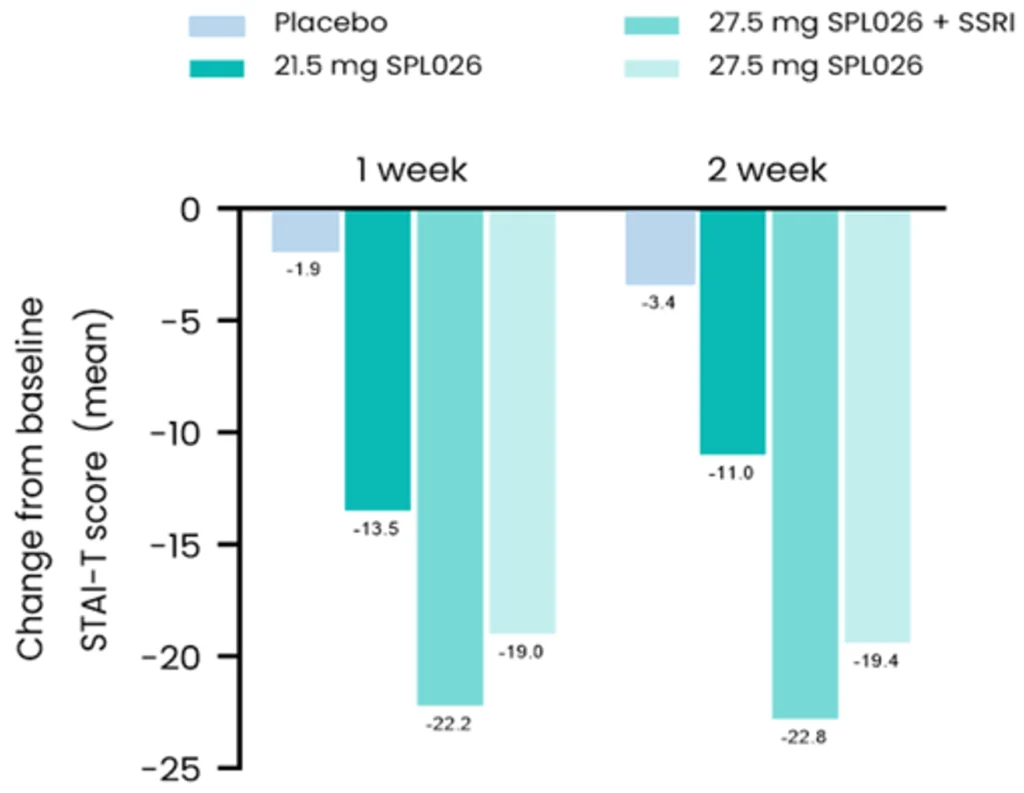
An exploratory analysis of Phase 2a and Phase 1b results for SPL026 (IV) an undeuterated analog of HLP004 showed significant improvements in measures of anxiety in participants with MDD.
At two weeks, participants on SPL026+SSRIs showed a mean 23-point improvement from baseline on the State Trait Anxiety Inventory – Trait version (STAI-T).
These results suggest a reduction in anxiety symptoms with IV treatment in patients with depression.
This supports the development of HLP004 for the treatment of anxiety disorders, especially as there are high rates of comorbidity between depression and anxiety.
Significant Unmet Need in
Generalized Anxiety Disorder
Over 300 million people suffer from anxiety disorders worldwide.1
GAD is the most common anxiety disorder seen in primary care, with a 12-month prevalence of 2.9% in the U.S.2
Approximately 77% of adults with GAD experience moderate to severe impairment.3
50% of patients with GAD do not respond to first line treatment with antidepressants such as SSRIs and SNRI.2

Phase 2 HLP004
Proof-of-Concept Study in GAD
Helus Pharma’s Phase 2 study of HLP004 is designed to evaluate the feasibility of treatment in GAD, including response to two different doses that could be evaluated in Phase 3. This study is being conducted in the United States.
Phase 2 study design:
Randomized, double-blind study in 36 participants with moderate to severe GAD (GAD-7 score ≥10)
Two IM doses, three weeks apart vs. two low-dose controls
Primary endpoint: change in Hamilton Anxiety Rating Scale (“HAM-A”) score from baseline at 6 weeks following the first dose
Participants will be followed for a period of twelve weeks, with additional optional follow-up assessments up to a year
To learn more about the Company’s pipeline programs and upcoming milestones, please visit the Development Pipeline page.
Sources:
1) Yang et al. (2021). Global, regional and national burden of anxiety disorders from 1990 to 2019: results from the Global Burden of Disease Study 2019. Epidemiology and Psychiatric Sciences 30, e36, 1–11. https://doi.org/10.1017/S2045796021000275/
2) Ansara E. D. (2020). Management of treatment-resistant generalized anxiety disorder. The mental health clinician, 10(6), 326–334. https://doi.org/10.9740/mhc.2020.11.326
3) Kessler et al. (2005). Prevalence, severity, and comorbidity of 12-month DSM-IV disorders in the National Comorbidity Survey Replication. Arch Gen Psychiatry, 62(6):617-27.